Akshaya Tritiya 2026: Honour Tradition, Build Wealth
Introduction
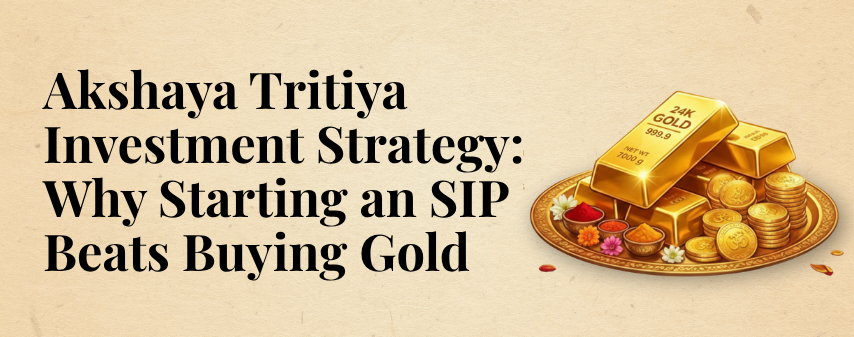
For generations, Akshaya Tritiya has been the auspicious day to bring home gold. The word Akshaya means “never diminishing,” and tradition suggests that gold bought on this day ensures eternal prosperity.
But in 2026, a hard financial reality is setting in: The entry barrier for gold has become a mountain.
While the sentiment is beautiful, the price tag is staggering. If your goal is true wealth creation rather than just following a ritual, it’s time to pivot. This year, consider trading the jeweler’s showroom for a meaningful SIP (Systematic Investment Plan) journey.
The Akshaya Tritiya Gold Price Trap
The biggest hurdle today isn’t a lack of faith; it’s the sheer cost of entry. Over the last decade, gold has transitioned from an accessible savings tool to a high-ticket luxury.
Look at how the “entry price” for Akshaya Tritiya has surged. You aren’t just buying gold; you’re buying into a massive price rally.
10 Years of Gold Prices on Akshaya Tritiya (Per 10g)
* Historical gold price data sourced from https://www.ibjarates.com https://www.mcxindia.com
Notice the pattern: The festival day price is almost always higher than the day before. Demand-driven buying pushes prices up exactly when everyone wants to buy. In 2016, you could begin your tradition with ₹30,000. Today, you need close to ₹1,00,000 for that same 10g coin.
Akshaya Tritiya Gold vs SIP: What Actually Grows Your Money?
Is buying gold once a year truly the best strategy for your future? Let’s compare a disciplined SIP with the traditional approach.
Lump Sum Gold vs Rupee Cost Averaging
When you buy gold once a year, you are at the mercy of that day’s market price. If gold is at an all-time high (like it is now), you’ve locked in a high purchase price.
An SIP, however, buys more units when the market is low and fewer when it’s high, averaging your costs and removing the “timing risk.” Read more about rupee cost averaging in detail
When you buy gold once a year, you are entirely at the mercy of that day’s market price. If gold is at an all-time high (as it is now), you’ve locked in the highest possible cost. An SIP, however, buys more units when the market is low and fewer when it’s high — automatically averaging your costs and removing “timing risk.” Learn more about rupee cost averaging from AMFI India.
Why SIPs Compound, Gold Doesn't
Gold is a “dead asset” in terms of cash flow. It doesn’t pay dividends or grow by itself — it only appreciates if the market says so. Equity SIPs, on the other hand, benefit from the power of compounding, where your returns themselves start generating returns over time. Want to know how it works before you start? Read how SIPs work for you in your wealth creation journey.
Akshaya Tritiya Gold vs SIP: The 10-Year Numbers
If you had started a monthly SIP of ₹5,000 back in 2016 instead of making a single gold purchase each year, here is what the numbers look like:
- Total Investment: ₹6,00,000
- Estimated Value (at 12% CAGR): ₹11–12 Lakh
- Gold Appreciation: While gold has grown significantly (from ₹30k to ₹98k), the SIP captures market corrections and growth in a way that a once-a-year purchase simply cannot match.
If you’re unsure how much to invest or which fund category suits your goals, take our risk profile assessment → to get started.
The Psychology Trap: "I Missed the Bus."
Many people look at gold prices in 2016 and sigh, “I should have started then.” But here is the truth: the best time to start was ten years ago. The second-best time is today.
Market volatility in 2026 isn’t a reason to wait — it’s a reason to start an SIP. Volatility is actually an SIP’s best friend, because it allows you to accumulate more units at lower prices over time.
“Don’t wait to invest. Invest and then wait.”
The Ritual Upgrade: Physical Gold vs. Gold ETF
If you feel the need to honour the tradition with a purchase, don’t head to the jewellery store. Even for a small “token” gesture, buying physical gold is the most expensive way to own it.
Instead, consider Gold ETFs (Exchange Traded Funds). You can buy a single unit, representing as little as 1 gram, through your Demat account instantly. It fulfils the ritual of “buying gold” without the massive hidden costs.
Physical Gold vs. Gold ETF: The Real Difference
This year, even if it’s just for shagun, buy a small token of Gold ETF. It’s auspicious, instant, and far more cost-effective than walking into a showroom.
The Akshaya Tritiya Resolution: > “I will invest in my future, not just in a tradition.”
Conclusion Your Akshaya Tritiya Resolution This Year
Start your “Akshaya” wealth journey today
- This Akshaya Tritiya, don’t just follow tradition — upgrade it. ✓
- Do a small Gold ETF purchase for Shagun ✓
- Start a SIP for long-term wealth creation ✓
Get a personalized plan from Dhanvantree. Contact Now.
Note: Mutual fund investments are subject to market risks. Please read all scheme-related documents carefully before investing. The past performance of the schemes is neither an indicator nor a guarantee of future performance.