

India GDP Growth 7.8%: What It Means for the Economy and Investors
Introduction
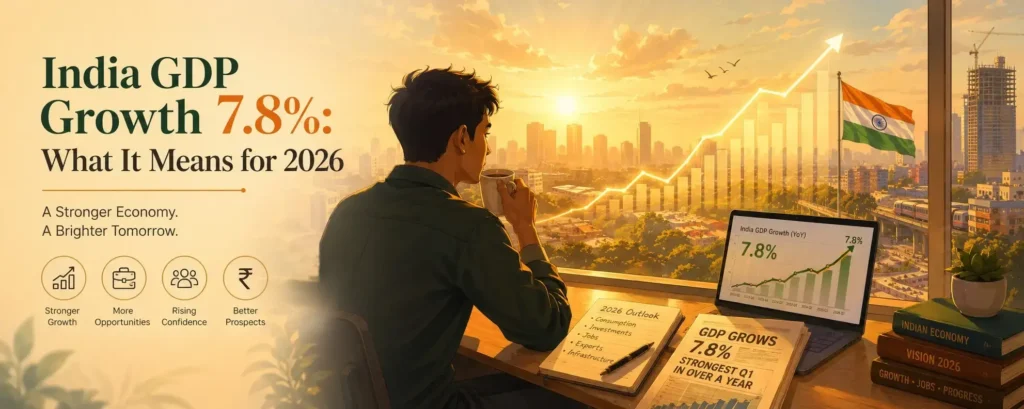
On August 31, 2026, the government released a number that surprised everyone. India’s GDP growth came in at 7.8% for the India Q1 FY27 GDP, marking one of the strongest starts to a fiscal year in recent memory.
That’s a full point higher than the 6.9% growth seen a year ago. It’s also well above what economists expected.
In rupee terms, the economy produced about ₹81.4 lakh crore worth of goods and services. That’s up from ₹75.5 lakh crore a year earlier.
There’s also a “nominal” number: 10.3%. This one doesn’t adjust for inflation. The gap between the two numbers tells us something useful: prices only rose mildly, around 2.5%. So this was real growth, not just higher prices.
One honest note, though. India’s economic growth did cool a bit from last quarter’s 8.6%. This isn’t the economy suddenly speeding up. It’s the economy staying strong, just slightly slower than before.
The way GDP is measured has also changed. Earlier in 2026, the government switched to a new GDP series. It uses a more recent base year (2022–23, instead of 2011–12). It smooths out quarter-to-quarter jumps. And it pulls in better data from GST filings, small business surveys, and vehicle registrations. It’s a real improvement. But it also means today’s numbers don’t compare perfectly to old data from years ago.
Why India's GDP Growth of 7.8% Surprised Economists
To see why this mattered, rewind to how things looked before the quarter began.
The mood was cautious. Conflict in West Asia was pushing oil prices around. Global trade was jumpy over tariffs. Supply chains were under strain almost everywhere.
India's Q1 FY27 GDP Numbers, Explained
Most forecasts for India sat around 7.1–7.3% growth. That’s a decent number. But it was a step down from the pace India had been running at.
So beating that forecast by half a point or more wasn’t small. It showed the economy was absorbing shocks better than most models expected.
What's Driving India's Economic Growth in 2026
Behind the headline number, the picture is mixed. Some parts of the economy did the heavy lifting. Others lagged behind.
Sectors Powering India's Manufacturing Growth
What worked:
- Investment surged. Spending on factories, roads, and infrastructure grew fast. Government capital spending led the way. The Centre alone spent nearly 28% of its full-year infrastructure budget in this one quarter.
- Households kept spending. Leftover benefits from earlier tax cuts helped.
- Factories and construction stayed busy. Manufacturing grew close to 9%. Construction grew around 7.7%. That’s a strong showing for a part of the economy that usually lags.
- Services remained the biggest engine. This sector grew around 10%. Banking, real estate, and professional services led the way, growing over 12%.
Where India's GDP Growth Fell Short
What didn’t:
- Agriculture grew just 3.6%, down from 4.4% last year. It’s still the most weather-dependent part of the economy, and still the slowest.
- Mining actually shrank, down about 2.4%. That’s a sharp reversal from over 12% growth a year ago.
GDP vs GVA in India: What's the Difference
There’s a subtler number worth knowing about too: GVA, or Gross Value Added.
GVA strips out taxes and subsidies. This quarter, it grew slightly faster than India’s GDP growth rate: 8.2% versus 7.8%.
That gap tells a story. It suggests the government absorbed more subsidy costs this quarter, likely to keep fertilizer and fuel prices in check for the public, instead of passing that cost on. In other words, the underlying economy may have done even a bit better than the headline number shows.
How India's GDP Growth Fits the Make in India Goal
This quarter’s numbers connect to a goal the government has chased for years: building up manufacturing so it carries more weight alongside services, and reducing how exposed the economy is to farm output and global commodity swings.
A quarter where manufacturing outgrows the overall economy, like this one, is exactly the kind of result the Make in India push has been aiming for.
The heavy government spending on infrastructure reflects a deliberate strategy too. Build now, the thinking goes, so private investment follows later and growth becomes self-sustaining.
RBI's GDP Forecast vs Actual Growth
The Reserve Bank of India (RBI) is more cautious, though. Its full-year GDP forecast sits around 6.7%, well below this quarter’s pace. That tells you where policymakers think the real work still needs to happen: keeping inflation low and steady, while manufacturing and exports do more of the heavy lifting over time. One strong quarter isn’t proof of a lasting shift.
The Bottom Line on India's GDP Growth
A 7.8% GDP growth print, delivered while oil markets wobbled and global trade stayed tense, is a genuinely strong result.
It was built on real foundations: heavy investment, resilient consumer spending, and a manufacturing sector that finally pulled its weight instead of trailing behind services.
But it’s not a number to take at face value. Some of the strength came from temporary boosts, like the lingering effect of tax cuts, that won’t repeat indefinitely. Agriculture is still lagging. And the measuring stick itself has just been overhauled, so this quarter is as much a new baseline as it is a victory lap.
The real story isn’t this one number. It’s whether India can carry this momentum into the next few quarters once the one-off tailwinds fade. And whether the investment surge seen here turns into the kind of sustained, private-sector-led growth the government has been building toward all along.
Important Disclosure: Dhanvantri Capital Services Private Limited is an AMFI Registered Mutual Fund and SIF Distributor (ARN-194216). Mutual fund investments are subject to market risks. Please read all scheme-related documents carefully before investing. Past performance may or may not be sustained in the future and should not be construed as an indicator of future returns.
Table of Contents
Frequently Asked Questions
It signals strength in investment-heavy and manufacturing-linked sectors, which is generally positive for equities tied to infrastructure, real estate, and industrial production. It also suggests the RBI has less pressure to cut rates aggressively, since growth remains healthy alongside mild inflation.
GDP (Gross Domestic Product) includes net taxes minus subsidies. GVA (Gross Value Added) strips these out and measures raw economic output. In this quarter, GVA grew 8.2% versus GDP’s 7.8%, showing the government absorbed more subsidy costs than usual.
Partly. Some of the strength came from temporary factors, like lingering effects of earlier tax cuts, that will fade over time. Sustained growth will depend on whether private investment picks up where government capital spending leaves off, and whether agriculture stabilizes.
Strong growth paired with mild inflation (around 2.5%) gives the RBI room to stay steady rather than cut or hike rates aggressively. The RBI’s own full-year forecast of 6.7% is more conservative than this quarter’s pace, suggesting a cautious, wait-and-watch approach.
Services led at around 10% growth, with banking, real estate, and professional services growing over 12%. Manufacturing grew close to 9% and construction around 7.7%. Agriculture (3.6%) and mining (which contracted 2.4%) were the weak spots.
Leave a Reply