

Dhanvantree

Dhanvantree

Dhanvantree

How to Choose Winning Mutual Funds for Confident Investing

the hero image of How to Choose Winning Mutual Funds for Confident Investing blog by dhanvantree

Introduction

With thousands of schemes available, selecting the right mutual fund can feel like searching for a needle in a haystack. While past performance often catches attention, smart investors know that choosing winning mutual funds requires a mix of quantitative analysis and qualitative judgment.

In this blog, we’ll break down proven strategies and key metrics so you can confidently pick funds that align with your financial goals and deliver consistent returns.

Define Investment Objectives

A successful investment journey begins with clarity of purpose. Start by identifying specific financial goals—whether it’s retirement planning, a child’s education, buying a home, wealth creation, or generating regular income.

Equally important is defining the time horizon:

  • Short term (1–3 years): Prioritize stability.

  • Medium term (3–5 years): Balance growth and safety.

  • Long term (5+ years): Focus on wealth creation.

Your objectives also determine whether capital appreciation (growth focus) or capital preservation (stability focus) is the priority. This foundation helps narrow down whether equity, debt, or hybrid mutual funds best suit your needs.

Assess Your Risk Tolerance

Risk appetite varies across individuals based on age, income, life stage, and personality. An aggressive young professional may be comfortable with equity funds, while someone nearing retirement may prefer debt or balanced funds.

By honestly evaluating your comfort level with market volatility, you can avoid panic-driven exits during downturns. Matching risk tolerance with fund choice ensures you stay invested long enough to reap the benefits of compounding.

Understand Asset Allocation

Diversification is a cornerstone of successful investing. Asset allocation—the mix of equities, debt, gold, or even international exposure—reduces reliance on a single asset class.

A well-balanced portfolio:

  • Shields against extreme downturns.

  • Spreads risk across sectors and markets.

  • Aligns with both your risk appetite and investment horizon.

Getting this allocation right helps create a smoother, more resilient investment journey.

Evaluate Fund Categories and Strategy

Different funds serve different purposes:

  • Equity funds: High growth potential, but come with volatility.

  • Debt funds: Lower risk and steady returns, ideal for conservative investors.

  • Hybrid funds: A balanced mix of growth and stability.

Beyond categories, examine the fund’s investment strategy. Does it follow a growth approach, value investing, or focus on sectoral/thematic bets? The chosen strategy should align with your personal investment philosophy and long-term objectives.

Scrutinize Performance History

Past performance is no guarantee of future returns, but it offers important clues. When reviewing performance:

  • Look at 1–3 year returns for short-term behavior.

  • Study 5+ year returns for long-term consistency.

  • Ensure the fund regularly outperforms its benchmark and peers across different market cycles.

  • Favor fund houses with 10–20+ years of credibility, as longevity signals stability.

Consistency across cycles is a hallmark of winning mutual funds.

Consider Fund Manager and Fund House

Behind every winning fund is a skilled team. Evaluate both the fund manager and the fund house:

  • A manager with a proven, long-term track record inspires confidence.

  • The fund house should demonstrate robust investment processes, risk management, and philosophy.

  • Apply the “4 Ps” framework—People, Process, Policy, and Philosophy.

Trustworthy management ensures your money is handled with discipline.

Monitor Portfolio Transparency and Holdings

Transparency builds trust. Winning funds disclose their holdings regularly, allowing investors to gauge concentration risks.

Questions to ask:

  • Are top holdings overly concentrated in a few stocks?

  • Is the portfolio well-diversified across sectors and themes?

Funds with a broad, balanced portfolio are better equipped to withstand downturns.

Rebalance and Review Regularly

Even the best mutual fund is not a “buy and forget” product. Review your portfolio at least once a year to ensure it still matches your goals and risk profile.

  • Replace funds that consistently underperform.

  • Adjust allocation as your life stage and financial needs evolve.

  • Rebalance categories to avoid overexposure.

Staying proactive keeps your portfolio aligned with long-term objectives.

Conclusion

To choose winning mutual funds, investors must blend personal clarity with professional evaluation. It’s about more than chasing past performance—it requires defining goals, assessing risk, diversifying smartly, and constantly reviewing.

When you approach mutual fund investing with discipline, consistency, and knowledge, you empower yourself to build a portfolio that not only withstands market volatility but also steadily grows wealth over time.

If you’d like expert guidance in selecting funds that truly match your goals, Dhanvantree, an AMFI-registered mutual funds distributor, can assist you in this journey. With professional insights and a structured approach, you can invest with greater confidence and clarity.

Note: Mutual fund investments are subject to market risks. Please read all scheme-related documents carefully before investing. The past performance of the schemes is neither an indicator nor a guarantee of future performance.


Table of Contents

Ready to make your first investment? Get in touch.

SEBI's Proposed Reforms for Mutual Funds: A Guide for Indian Investors

The hero image of SEBI's Proposed Reforms for Mutual Funds: A Guide for Indian Investors blog by dhanvantree

Introduction

The Indian mutual fund industry is heading toward a landmark transformation. SEBI’s Proposed Reforms for Mutual Funds, released as part of a draft circular on July 18, 2025, introduce sweeping changes in the way schemes are categorised, managed, and offered to investors. These reforms are aimed at eliminating portfolio overlaps, promoting innovation, and increasing transparency—ultimately making the mutual fund ecosystem more investor-friendly.

This guide will walk you through what these Proposed Reforms mean for your financial future.

Why SEBI's Proposed Reforms for Mutual Funds Matter

At the heart of SEBI’s Proposed Reforms for Mutual Funds is the principle of “true-to-label” investing. SEBI wants every scheme’s name to accurately reflect its actual investment strategy. This helps you, as an investor, make informed decisions without getting lost in complex or misleading scheme names.

SEBI observed widespread portfolio overlap within fund houses, leading to confusion and reduced differentiation. These proposed reforms aim to tighten controls, foster unique investment offerings, and boost investor confidence through better transparency.

Breakdown of SEBI's Proposed Reforms for Mutual Funds by Scheme Type

The draft circular encompasses 20 proposals, meticulously spread across five main categories: Equity, Debt, Hybrid, Solution-oriented schemes, and Other Schemes. Here’s a closer look at some of the SEBI’s Proposed Reforms for Mutual Funds.

Equity Funds: More Choices, Less Overlap

SEBI is looking to provide greater flexibility while maintaining distinct investment strategies for equity funds.

  • Value and Contra Funds: Fund houses might soon be able to launch both Value Funds and Contra Funds. However, a critical condition is that the portfolio overlap between these two schemes must not exceed 50% at any given time. This ensures that while you have more options, each scheme retains its unique investment philosophy and investment style.
  • General Portfolio Overlap: For other equity schemes, the portfolio overlap generally should not exceed 50%. This will be rigorously monitored during New Fund Offers (NFOs) and semi-annually thereafter. This focus on distinct investment strategies aims to provide clearer choices for Indian investors.
  • Rebalancing and Exit Options: If a fund house breaches the portfolio overlap limit, they will have 30 days to rebalance. Should the overlap persist beyond the permitted period, investors will be offered an an exit option without any exit load, safeguarding their interests.
  • Residual Assets Flexibility: Equity funds will have more flexibility in deploying their residual portion (the part of the portfolio not invested in the primary asset class). This can now include investments in debt, gold, silver, Real Estate Investment Trusts (REITs), and Infrastructure Investment Trusts (InvITs), within regulatory limits. This allows for more dynamic portfolio management and diversification opportunities.

These changes under SEBI’s Proposed Reforms for Mutual Funds aim to ensure you get truly differentiated equity options.

Debt Funds: Clearer Terms and New Avenues

The proposals for debt funds focus on enhancing clarity and introducing new investment avenues.

  • “Term” instead of “Duration”: The term ‘Duration’ in debt fund names is proposed to be changed to ‘Term’ for better clarity, making it easier for investors to understand the fund’s investment horizon. For example, ‘Low Duration Fund’ will be renamed to ‘Ultra Short to Short Term Fund’.
  • Displaying Average Maturity: All debt funds will be required to clearly display their average maturity term (e.g., Overnight Fund – 1 day; Medium Term Fund – 3–4 years). This will help you make more informed decisions based on your investment horizon and risk appetite.
  • Sectoral Debt Funds: Fund houses may be allowed to launch sectoral debt funds. This will open up new specialized investment opportunities, provided the portfolio overlap between any two such schemes does not exceed 60%, and there’s sufficient availability of investment-grade paper in the chosen sectors. This innovation could provide more targeted wealth-building opportunities.
  • REITs and InvITs in Residual Portion: Similar to equity funds, the residual portion of existing debt funds (excluding short-duration funds like overnight and liquid funds) can also be deployed in REITs and InvITs, offering additional avenues for diversification.

These debt-related initiatives under SEBI’s Proposed Reforms for Mutual Funds simplify product selection and enable more targeted investing.

Hybrid Funds: Sharper Definitions and Diversification

Hybrid funds, which offer a blend of asset classes, will also see some refinements aimed at better defining their characteristics and providing diversification.

  • Arbitrage Fund Focus: Arbitrage funds may be restricted to investing their debt portion only in government securities or repos backed by such securities, aiming for clearer risk-adjusted returns.
  • Equity Savings Scheme Exposure: Equity Savings Schemes may be required to maintain a net equity and arbitrage exposure between 15% and 40%, with defined minimum allocations to equity and debt, ensuring their true nature as a hybrid offering.
  • REITs and InvITs: Most hybrid funds, including solution-oriented schemes (except arbitrage funds and dynamic asset allocation funds), will be allowed to invest in REITs and InvITs, further expanding diversification avenues.
  • Multi-Asset Funds: Foreign securities will be treated as a separate asset class in multi-asset funds, providing greater clarity on diversification within these schemes.

With these shifts, SEBI’s Proposed Reforms for Mutual Funds help hybrid investors achieve better-defined and safer diversification.

Solution-Oriented Schemes: Lifecycle Investing with Lock-ins

A significant proposal for solution-oriented funds is the allowance for lifecycle fund of funds (FoFs) with a target date.

  • Target Date FoFs: Imagine a Retirement Lifecycle FoF 2040, structured to gradually shift its investments from equity to hybrid and then to debt funds as it approaches its target date. These FoFs will have a lock-in period aligned with their target date, encouraging long-term, goal-based investing. This is a great step towards tailored financial planning, aligning your investments with your life goals.

Other Schemes: Introducing Second Schemes in a Category

Perhaps the most innovative proposal is the allowance for additional schemes in the same category:

  • Second Scheme in a Category: Fund houses can launch a second scheme only if the original is over five years old and has AUM above ₹50,000 crore.
  • Subscription Freeze for Original Scheme: Once a second scheme is introduced, the original scheme must stop accepting new investments.
  • Naming Convention & Structure: New schemes must match the strategy and asset allocation of the original and clearly state series numbers (e.g., Series 1, Series 2). The Total Expense Ratio (TER) must also remain consistent.

These proposals within SEBI’s Proposed Reforms for Mutual Funds aim to foster product innovation without sacrificing clarity or investor trust.

What's Next?

SEBI is seeking feedback on the draft reforms until August 8, 2025, via its official portal. As an informed investor, this is your opportunity to shape the future of India’s mutual fund industry.

SEBI’s Proposed Reforms for Mutual Funds are a bold move toward greater transparency, product innovation, and investor protection. By offering clearer definitions and increased options, SEBI empowers you to build smarter, goal-oriented portfolios.

Note: Mutual fund investments are subject to market risks. Please read all scheme-related documents carefully before investing. The past performance of the schemes is neither an indicator nor a guarantee of future performance.

Table of Contents

Ready to make your first investment? Get in touch.

Avoid Common Mutual Fund Mistakes in Your Investments

hero image of Avoid Common Mutual Fund Mistakes in Your Investments blog by dhanvantree

Introduction

Mutual funds are a favored investment option in India, offering both growth potential and diversified exposure to financial markets. However, investors often fall prey to Common Mutual Fund Mistakes. Recognizing and avoiding these pitfalls is key to making informed decisions and crafting a resilient investment strategy.

1. Investing Without Clear Financial Goals

One of the biggest Common Mutual Fund Mistakes is investing without a specific purpose. If you don’t know why you’re investing, your strategy will lack direction.

  • The Error: Just putting money into mutual funds without a goal like retirement, a child’s education, or buying a house.

  • How to Avoid: Define your financial goals clearly. For example, “I want to save ₹50 lakhs for my child’s higher education in 15 years.” This clarity guides your fund choices and keeps you focused.

2. Chasing Past Performance

It’s tempting to pick mutual funds based on recent high returns, but this is a frequent Common Mutual Fund Mistake. Past performance doesn’t guarantee future success.

  • The Error: Assuming a fund that did well last year will continue to do so.

  • How to Avoid: Look at a fund’s consistent performance over several years (3, 5, 10 years) and through different market conditions. Understand its investment approach and how it fits your long-term goals and risk appetite.

3. Ignoring Your Risk Appetite

Every investor has a unique comfort level with risk. Investing in funds that are too risky or too conservative for you is another of the Common Mutual Fund Mistakes.

  • The Error: Choosing aggressive equity mutual funds when you’re uncomfortable with market swings, or being too cautious and missing out on growth.

  • How to Avoid: Assess your personal risk tolerance. Consider your age, income, and how you’d react to market downturns. Pick mutual funds that match your comfort level.

4. Not Diversifying Your Portfolio

Putting all your investment eggs in one basket is a classic Common Mutual Fund Mistake that exposes you to unnecessary risk.

  • The Error: Concentrating all your investments in just one or two mutual funds or sectors.

  • How to Avoid: Spread your investments across different mutual fund types (e.g., large-cap, mid-cap, debt, hybrid funds). This diversification helps reduce risk by balancing out potential losses in one area with gains in another, aiding wealth-building.

5. Attempting to Time the Market

Trying to predict market highs and lows to buy low and sell high is one of the most common and often costly Common Mutual Fund Mistakes.

  • The Error: Believing you can consistently enter and exit the market at the perfect time.

  • How to Avoid: Use a Systematic Investment Plan (SIP). Regular investments through SIPs leverage rupee cost averaging, buying more units when prices are low and fewer when high. This disciplined approach eliminates the need for market timing and fosters long-term compounding and wealth-building.

6. Neglecting Periodic Portfolio Review

Once you invest, it’s easy to forget about your portfolio. But not reviewing it regularly is another of the significant Common Mutual Fund Mistakes.

  • The Error: Failing to check if your mutual fund portfolio still aligns with your changing goals and market conditions.

  • How to Avoid: Review your portfolio at least once a year. This helps you confirm your investments are still meeting your objectives and allows you to make necessary adjustments or rebalance your asset allocation.

By understanding and consciously avoiding these Common Mutual Fund Mistakes, Indian investors can build a stronger, more resilient portfolio and confidently work towards their financial aspirations.

How Dhanvantree Can Help You

At Dhanvantree, an AMFI registered Mutual Funds Distributor, we’re dedicated to helping you make informed investment decisions. We guide you through defining your financial goals, understanding your risk appetite, and building a diversified portfolio. Our aim is to help you avoid these Common Mutual Fund Mistakes and achieve your wealth-building dreams with clear, client-centric advice.

Are your mutual fund investments optimized to avoid these common mistakes? Let’s connect and ensure your portfolio is perfectly aligned with your financial goals.

Note: Mutual fund investments are subject to market risks. Please read all scheme-related documents carefully before investing. The past performance of the schemes is neither an indicator nor a guarantee of future performance.

Table of Contents

Ready to make your first investment? Get in touch.

Monthly vs. Quarterly SIP: Which Is Better for Your Wealth Journey?

hero image of Monthly vs. Quarterly SIP: Which Is Better for Your Wealth Journey blog by dhanvantree

Introduction

Many Indian investors embrace the Systematic Investment Plan (SIP) as a disciplined way to build wealth. But once you decide to start a SIP, a common question arises: should I opt for a monthly or quarterly frequency? While both serve the fundamental purpose of consistent investing, understanding their nuances can help you align your SIP with your financial comfort and goals.

The truth is, for long-term wealth creation, the frequency of your SIP often has a marginal impact on overall returns. What truly matters is starting early, staying invested, and maintaining discipline. However, each frequency offers distinct advantages that might better suit your income patterns and lifestyle.

Understanding the Monthly SIP

The monthly SIP is arguably the most popular choice among Indian investors, and for good reason. It seamlessly aligns with the typical monthly income cycle of most salaried individuals.

Advantages of a Monthly SIP:

  • Ease of Budgeting: Most people receive their salaries monthly, making it straightforward to allocate a fixed sum for their SIP at the beginning of each month. This simplifies financial planning and ensures consistent contributions.

  • Optimal Rupee Cost Averaging: By investing every month, you spread your purchases across different market cycles. When the market is down, your fixed investment buys more units; when it’s up, it buys fewer. This rupee cost averaging helps average out your purchase cost over time, mitigating the impact of market volatility.

  • Promotes Discipline: A monthly debit instills a strong sense of financial discipline, making investing a regular habit rather than a sporadic event.

Exploring the Quarterly SIP

While less common than monthly SIPs, quarterly SIPs cater to a specific segment of investors whose income patterns are not monthly.

Advantages of a Quarterly SIP:

  • Suited for Irregular Income: If you are a freelancer, business owner, or someone who receives income in quarterly installments (like bonuses or commissions), a quarterly SIP can align better with your cash flow.

  • Less Frequent Transactions: For those who prefer a more hands-off approach and fewer debits from their bank account, a quarterly SIP reduces the administrative burden.

  • Larger Ticket Size (Potentially): Since the investment is made less frequently, you might opt for a larger amount per installment, which can be psychologically appealing for some investors.

Key Considerations for Your Choice

When deciding between a monthly and quarterly SIP, consider these factors:

  • Your Income Cycle: The most practical approach is to choose a frequency that matches how you receive your income. For salaried individuals, monthly is typically more convenient.

  • Investment Amount: If you are starting with a smaller amount, a monthly SIP might be more manageable. For larger sums, a quarterly SIP could work.

  • Market Volatility: While both frequencies benefit from rupee cost averaging, monthly SIPs provide more frequent entry points, which can slightly enhance averaging in highly volatile markets. However, over the long term, this difference tends to be minimal.

  • Convenience and Monitoring: Monthly SIPs generally offer more ease of management and tracking due to their consistent, regular nature.

Final Thought

Ultimately, whether you choose a monthly or quarterly SIP, the most crucial element for building substantial wealth is consistency and long-term commitment. A SIP is a powerful tool designed to simplify investing and harness the power of compounding. Don’t get caught up in trying to perfectly time the market or agonizing over minor differences in SIP frequency. The real advantage comes from staying invested through various market cycles.

Is your SIP aligned with your financial goals? Do you have a comprehensive financial plan in place? At Dhanvantree, as AMFI-registered mutual fund distributors, we believe in providing client-first guidance to help you navigate your investment journey. We can help you assess your income patterns, financial objectives, and risk tolerance to determine the optimal SIP strategy for you.

Note: Mutual fund investments are subject to market risks. Please read all scheme-related documents carefully before investing. The past performance of the schemes is neither an indicator nor a guarantee of future performance.

Table of Contents

Ready to make your first investment? Get in touch.

Does BAFs pay off during market downturn?

hero image of Does BAFs pay off during market downturn blog by dhanvantree

Introduction

Market downturns can be unsettling. The headlines might scream about falling indices, and naturally, concerns about your investments arise. This is where Balanced Advantage Funds (BAFs), also known as Dynamic Asset Allocation Funds, often shine. Unlike pure equity funds, BAFs are designed with an inherent mechanism to navigate market volatility, making them a compelling option during periods of uncertainty.

How BAFs Function During Market Swings

The core philosophy of a BAF is its dynamic asset allocation strategy. Instead of maintaining a fixed ratio of equity and debt, BAFs actively adjust their portfolio mix based on market conditions and pre-defined models. This flexibility is key to their performance during downturns:

  • “Buy Low, Sell High” in Action: When equity markets appear overvalued (e.g., high Price-to-Earnings or Price-to-Book ratios), BAFs typically reduce their equity exposure and increase their allocation to safer debt instruments. This proactive shift helps cushion the impact when the market corrects.
  • Averaging Down: Conversely, when markets are undervalued or fall significantly, BAFs increase their equity allocation, buying more units at lower prices. This “rupee cost averaging” approach helps them capture the upside when the market eventually recovers.
  • Hedging Strategies: Many BAFs also employ hedging techniques using derivatives (like futures and options) to further manage market risk. This can help them maintain a higher gross equity exposure for tax benefits while keeping the net equity risk low during volatile phases.

The Downside Protection Advantage with BAFs

While no fund can guarantee returns or complete insulation from market risks, BAFs generally offer better downside protection compared to pure equity funds during market downturns. For instance, recent market data has shown that while a broader market index might decline significantly, BAFs have often managed to limit their fall to a much lesser extent. This ability to mitigate losses is a significant advantage for investors who prefer a smoother investment journey and are not comfortable with sharp swings in their portfolio value.

The Trade-Off: Modest Upside in Bull Markets

It’s important to understand that the very mechanism that provides downside protection in BAFs can also mean they may not keep pace with pure equity funds during strong bull markets. Since they trim equity exposure when valuations are high, they might miss out on some of the peak gains. Therefore, BAFs are ideal for:

  • Conservative to Moderate Risk-Takers: Investors who prioritize capital preservation and stable returns over aggressive growth.

  • First-Time Investors: Those new to mutual funds who want a professionally managed solution that reduces the need for active market timing.

  • Investors Seeking a Balanced Approach: Individuals who want exposure to both equity growth potential and debt stability without the constant need to rebalance their own portfolio.

Final Thought

Balanced Advantage Funds can indeed “pay off” during market downturns by acting as a stabiliser for your portfolio. They provide a disciplined, model-based approach to investing that takes emotions out of the equation. If you’re an Indian investor looking for a solution that aims to navigate market volatility with a focus on risk-adjusted returns and long-term wealth creation, a BAF could be a valuable addition to your financial plan.

Is your investment portfolio aligned with your risk appetite and long-term financial goals? At Dhanvantree, we believe in crafting financial strategies that truly serve your aspirations. As an AMFI registered Mutual Funds Distributor, we can help you understand how Balanced Advantage Funds fit into your broader financial plan and whether they align with your investment goals and risk tolerance. Reach out to us for a personalized consultation.

Note: Mutual fund investments are subject to market risks. Please read all scheme-related documents carefully before investing. The past performance of the schemes is neither an indicator nor a guarantee of future performance.

Table of Contents

Ready to make your first investment? Get in touch.

Top-Up SIPs: Grow Your Wealth Effectively with Your Rising Salary!

the hero image of Top-Up SIPs: Grow Your Wealth Effectively with Your Rising Salary blog

Introduction

You’ve been investing smartly through SIPs. You understand the power of compounding. And you’ve probably seen some good returns already. But here’s the million-rupee question—have you increased your SIPs as your income grew?

If not, it’s time to meet your new financial best friend: Top-Up SIPs.

They’re the easiest way to let your investments grow automatically with your rising income—without the usual paperwork or second-guessing.

Let’s break it down in simple terms.

What is a Top-Up SIP?

A Top-Up SIP (also known as a Step-Up SIP) allows you to automatically increase your SIP amount at regular intervals—either annually or half-yearly. So instead of investing ₹5,000 every month for 10 years, you can choose to increase your SIP by, say, ₹1,000 every year.

It’s as simple as telling your mutual fund distributor:
“Hey, increase my SIP amount by ₹1,000 every year from now on.”

This feature helps your investments grow in line with your income—without you needing to remember or take action every time your salary goes up.

Why Should You Consider a Top-Up SIP?

Here are some strong reasons why a Top-Up SIP can be a game-changer for your financial future:

  1. Keeps Pace with Your Lifestyle: As your income grows, your expenses might too. But unless your investments also grow, your wealth might not be enough to support future goals like a dream home, your child’s education, or an early retirement.
    Top-Up SIPs help your investments grow with your lifestyle—automatically.
  2. Power of Compounding Gets Supercharged: The more you invest, the more you benefit from compounding. A small increase in SIP every year can lead to a significantly larger corpus in the long run.
    Let’s say you start with ₹5,000 per month and increase it by ₹1,000 annually. In 15 years, your total investment would be far higher than a flat ₹5,000 SIP—and so would your wealth.
  3. Disciplined Wealth Creation, Without Stress: Once set up, a Top-Up SIP requires no manual work. No logging in, no updating instructions—just automatic wealth-building tailored to your growing capacity.
  4. Takes the Emotion Out of Investing: We all have that moment of hesitation—“Should I increase my SIP now? Or wait a few months?”
    Top-Up SIPs remove that emotional decision-making. You decide the rules once and let the system do the rest.

But How Do You Set It Up?

If you’re already investing in mutual funds, setting up a Top-Up SIP is easy. You just need to:

  • Choose the base SIP amount

  • Decide the top-up amount or percentage (e.g., ₹1,000 per year or 10% increase annually)

  • Set the frequency (usually yearly or half-yearly)

And that’s it—you’re good to go!

What If You’re Managing SIPs On Your Own?

If you’ve been investing without guidance, chances are you might have missed out on key strategies like this one.

Managing SIPs by yourself can be rewarding—but it can also become overwhelming. Questions like:

  • Am I investing in the right mutual fund category?

  • Should I switch or rebalance?

  • How do I align my SIPs with my retirement or tax planning?

These are where professional help makes a big difference.

How Dhanvantree Helps You Make the Most of Your SIPs

At Dhanvantree, we do more than suggest funds. We help you design a complete mutual fund strategy based on your goals, income growth, and risk appetite.

As an AMFI-registered Mutual Fund Distributor, our role is to simplify your financial journey—and Top-Up SIPs are just one of the tools we use to help you build long-term wealth with ease.

Here’s how we support you:

  • Customized SIP planning with Top-Up options

  • Regular portfolio reviews and rebalancing

  • Guidance on goal-based investing

  • Tax-smart mutual fund investments

  • Ongoing support and transparency across platforms

You don’t need to do it all alone. With the right expert on your side, you can stop guessing and start growing.

Ready to Let Your SIPs Rise With Your Salary?

Top-Up SIPs are one of the smartest, simplest ways to accelerate your financial journey. Whether you’re just starting out or looking to fine-tune your portfolio, this strategy ensures that your investments grow with you—not behind you.

So if you’re ready to let your money evolve as fast as your career, it’s time to act.

Note: Mutual fund investments are subject to market risks. Please read all scheme-related documents carefully before investing. The past performance of the schemes is neither an indicator nor a guarantee of future performance.

Table of Contents

Ready to make your first investment? Get in touch.

Why You Need a Mutual Fund Distributor—Even If You're a DIY Investor

Blogs Images (1)

Introduction

You’re not alone if you’ve ever dabbled in mutual fund investments or even just thought about it. Everyone starts with —scrolling through articles, watching YouTube videos, and trying to piece together the “best” mutual fund strategy on my own. But here’s what I’ve learned over the years: trying to go it alone can cost you more than just time—it can cost you actual returns.

That’s exactly why I want to talk to you today about something most people overlook: the value of a mutual fund distributor. Whether you’re just starting out, have been investing for years, or have tried managing your mutual funds on your own, there’s a strong case to be made for having an expert by your side.

First, Let’s Talk Basics—What Are Mutual Funds?

Before we get into why you should consider working with a distributor, let’s quickly cover what mutual funds are—because clarity always comes first.

A mutual fund is a pool of money collected from various investors, which is then invested in diversified securities like stocks, bonds, or a mix of both. These funds are managed by professional fund managers, so you don’t have to pick individual stocks or time the market (which, let’s be honest, is super tricky even for pros).

What makes mutual funds so popular?

  • Diversification – Your money is spread across different assets to reduce risk.

  • Professional management – Experts make decisions on your behalf.

  • Flexibility – You can invest in lump sum or start small with a SIP (Systematic Investment Plan).

  • Transparency – Mutual funds in India are regulated by SEBI (Securities and Exchange Board of India).

And yes, mutual funds are subject to market risk, but with the right strategy and guidance, those risks can be effectively managed.

Why DIY Investors Hit a Wall

I’ve met many people—engineers, teachers, small business owners, salaried class—who started investing in mutual funds through apps or platforms because it felt easy and low-cost. But soon enough, they faced common hurdles:

  • Too many fund options and no clue which one suits their goals.

  • Confusion around taxation rules and how to avoid paying more than needed.

  • Missed opportunities for rebalancing portfolios at the right time.

  • Panic during market downturns leading to impulsive exits.

Sound familiar?

This is where a mutual fund distributor makes a difference—not by selling you products, but by helping you build a strategy tailored to your life goals.

So, What Exactly Does a Mutual Fund Distributor Do?

Think of a mutual fund distributor like a friend who has knowledge of the financial market who’s here to consult, not push.

Here’s what we bring to the table:

  • Goal-based investment strategy – Whether it’s saving for a home, a child’s education, or retirement, we map investments to real-life goals.

  • Portfolio curation – We recommend funds based on your risk appetite, time horizon, and market conditions.

  • Periodic reviews – Because markets change, and so should your portfolio.

  • Tax efficiency – Helping you understand things like Section 80C deductions, capital gains, and how to optimize your investments accordingly.

  • Peace of mind – We monitor so you don’t have to stress every time the market dips.

The idea isn’t to replace your control over investments, but to empower your decisions with expertise.

Why You Should Work With Dhanvantree—

At Dhanvantree, we’re not just mutual fund distributors. We’re your long-term wealth partners. As an AMFI-registered mutual fund distributor, we’re authorized and regulated, which means you get trustworthy, transparent, and ethical advice every step of the way.

Here’s what makes us different:

  • We prioritize financial literacy—we explain before we recommend.

  • We focus on tailored strategies, not one-size-fits-all suggestions.

  • We help you track, manage, and update your investments with human insight (not just algorithms).

  • We are with you at every stage—from first SIP to eventual goal fulfillment.

Our motto is simple: From Financial Blunders to Dream Fulfillment. And we mean it.

Still Thinking “Why Not Just Do It Myself?”

That’s totally fair. After all, we all need to carefully think before making any decision. But ask yourself:

  • Are you confident your current funds align with your goals?

  • Do you have time to monitor markets, fund performance, and tax implications regularly?

  • Do you know when to switch funds or rebalance your portfolio?

  • Are you making emotionally-driven decisions during volatility?

If any of your answers is “I’m not sure” or “maybe,” then it’s worth having a conversation with a professional. Because in investing, what you don’t know can hurt your returns.

Final Thoughts:

Choosing a good mutual fund distributor involves more than just convenience—it means looking for proper certification, in-depth product knowledge, the ability to understand and support clients effectively, and a strong focus on trust and ethical practices.

When these qualities come together, you’re not just investing in mutual funds—you’re investing with clarity, confidence, and purpose. A qualified distributor like Dhanvantree, with its AMFI registration and client-first approach, ensures your portfolio is aligned with your life goals while keeping you informed every step of the way.

Note: Mutual fund investments are subject to market risks. Please read all scheme-related documents carefully before investing. The past performance of the schemes is neither an indicator nor a guarantee of future performance.

Table of Contents

Ready to make your first investment? Get in touch.

Should You Stop Your SIPs in Small and Mid-Cap Funds?

the hero image of Should You Stop Your SIPs in Small and Mid-Cap Funds blog by dhanvantree

Introduction

Recent drops in small and mid-cap indices have left investors questioning their investment strategies and whether they should stop their SIPs in small and mid-cap funds. Over the past two months, the BSE Small-Cap Index has declined by 18%, while the Mid-Cap Index has fallen by 17.61% in eight weeks. Since February 7, small-cap and mid-cap indices have lost 6% and 5.3%, pushing them into bear market territory.

This correction has led to a ₹1.1 lakh crore (3.26%) reduction in equity mutual fund assets under management (AUM). Small-cap funds saw an outflow of ₹23,665 crore (7.19%), while mid-cap funds shrank by ₹26,600 crore (6.65%). Given this downturn, many investors are asking, “Should you stop your SIPs in small and mid-cap funds, or should you stay invested?”

How Market Corrections Affect Your SIP in Small and Mid-Cap Funds

Small and mid-cap stocks offer high growth potential but come with significant volatility. Historically, these segments have faced sharp declines followed by strong recoveries. For example, during the 2008 financial crisis, small- and mid-cap funds fell up to 70%, only to gain over 70% the following year. Similarly, in the past three years, these funds have delivered returns as high as 100%.

For investors in SIPs, market downturns can be stressful. However, stopping your SIPs in small and mid-cap funds during a correction may not be the best move. The rupee cost averaging mechanism ensures that you buy more units at lower prices, improving long-term returns as the market recovers.

Should You Stop Your SIPs or Continue Investing in Small and Mid-Cap Funds?

Before deciding whether to stop your SIPs, consider the following key factors:

  1. Investment Timeframe: SIP in small and mid-cap funds is most effective when held for 5-10 years. Short-term volatility can lead to panic selling, but stopping SIPs prematurely can result in missed opportunities. If your financial goals align with a long-term investment strategy, continuing your SIPs may be the better option.
  2. Risk Tolerance: Small and mid-cap funds experience frequent market swings. If market fluctuations make you uncomfortable, instead of stopping your SIPs, consider adjusting your portfolio allocation. Diversifying across asset classes can help manage risk while maintaining your investment discipline.
  3. Valuation Levels: Despite recent declines, small- and mid-cap valuations remain relatively high. Instead of stopping SIPs entirely, some investors prefer reducing allocation temporarily. If you stop your SIPs completely, you may miss potential gains when markets rebound.
  4. Diversification: A well-diversified portfolio reduces overall risk. If you are considering stopping your SIPs in small- and mid-cap funds, reassess whether your current portfolio is balanced. Rather than pausing SIPs, shifting a portion of investments to large-cap or multi-cap funds could help manage risk.

Should You Stop Your SIPs or Invest More During This Correction?

Market corrections often present good entry points for disciplined investors. However, timing the market is difficult. Instead of stopping SIPs in small and mid-cap funds due to fear, consider if your risk appetite allows for additional investments.

For existing investors, historical data suggests that those who stay invested through market downturns outperform those who try to time exits and re-entries. If your financial goals remain unchanged, continuing your SIPs is likely the best course of action.

Portfolio Rebalancing: A Smarter Approach Than Stopping Your SIPs

Instead of stopping your SIPs entirely, consider rebalancing your portfolio to align with your changing risk appetite and financial goals. Portfolio rebalancing involves adjusting the allocation of your investments across different asset classes, such as large-cap, debt, or multi-cap funds, while maintaining exposure to small- and mid-cap funds as per your risk tolerance. During market corrections, rebalancing can help reduce downside risks while ensuring long-term wealth creation. If small- and mid-cap funds have grown disproportionately in your portfolio, shifting a portion to less volatile assets can provide stability without exiting the market completely. Conversely, if valuations become attractive, increasing SIP contributions in these funds could enhance long-term returns.

Frequently Asked Questions (FAQs)

1. What Happens If You Stop Your SIPs in Small-Cap Funds During Volatility?

Stopping SIPs in small- and mid-cap funds during downturns can lead to missed opportunities. SIP investments help average out costs over time, and exiting the market prematurely may lock in losses rather than allowing recovery.

2. Are mid-cap mutual funds safe during a market crash?

Large-cap funds are less volatile, but shifting from small- and mid-cap funds due to temporary market downturns might not be ideal. Instead of stopping your SIPs completely, a portfolio rebalance could be a better strategy based on your risk tolerance.

3. How Long Should You Stay Invested in Small- and Mid-Cap SIPs?

A minimum of 5-10 years is recommended to benefit from market cycles and compounding. If your investment horizon is shorter, consider reallocating instead of stopping your SIPs entirely.

4. Should I shift my SIPs to large-cap funds during volatility?

If your risk appetite has changed, you may consider rebalancing your portfolio. However, trying to time the market is usually not recommended.

Conclusion:

Market corrections are an inherent part of equity investing. While the recent decline in small- and mid-cap funds may seem concerning, stopping your SIPs based on short-term trends can be counterproductive.

For investors with a long-term horizon, SIP in small and mid-cap funds remains a disciplined investment approach. The rupee cost averaging effect allows for better gains as markets recover. The decision to continue or stop your SIPs should be based on risk tolerance, financial goals, and overall portfolio strategy.

If you are unsure whether you should stop your SIPs or make adjustments, consulting a financial expert can provide clarity tailored to your needs.

Note: Mutual fund investments are subject to market risks. Read all scheme-related documents carefully before investing. The past performance of the schemes is neither an indicator nor a guarantee of future performance.

Market corrections often present good entry points for disciplined investors. However, timing the market is difficult. Instead of stopping SIPs in small and mid-cap funds due to fear, consider if your risk appetite allows for additional investments.

Table of Contents

Ready to make your first investment? Get in touch.

January 2025 Mutual Funds: Strong Inflows and Growing Confidence

The hero image of January 2025 Mutual Funds Strong Inflows and Growing Confidence blog by Dhanvantree

Introduction

The Indian mutual fund industry experienced strong inflows in January 2025, reinforcing investor confidence in equity markets. In January 2025, mutual funds industry saw assets under management (AUM) reached an all-time high of ₹67.25 lakh crore, and various market segments saw significant investments, especially midcap and small-cap funds. However, a notable trend emerged as Systematic Investment Plan (SIP) closures exceeded new registrations, raising concerns about investor sentiment.

January 2025 Mutual Funds Inflows Reach New Highs

In January 2025 mutual funds industry experienced overall inflows, including New Fund Offers (NFOs), which remained robust at ₹40,000 crore, compared to ₹41,200 crore in December 2024. Excluding NFOs, inflows stood at ₹36,000 crore, marking a substantial rise from ₹30,000 crore in the previous month. This is the second-highest monthly inflow ever recorded, following the peak of ₹38,000 crore in October 2024. The trend indicates that investors are taking advantage of market corrections to build long-term wealth.

January 2025 Mutual Funds: SIP Contribution

SIPs continue to be a preferred investment route for retail investors due to their disciplined approach and rupee-cost-averaging benefits. In January, SIP contributions remained steady at ₹26,400 crore, a marginal decline from ₹26,459 crore in December.

However, for the first time since the COVID-19 pandemic, the SIP discontinuation ratio exceeded 100%, with 5 lakh more SIP closures than new registrations. Specifically, 56.19 lakh new SIPs were registered, while 61.33 lakh SIPs were discontinued. Despite this, the overall base of active SIP accounts remains strong at 10.27 crore, with approximately 6 crore new SIPs registered in FY25 alone.

Midcap and Small-Cap Funds Lead Investor Interest

Investor confidence in midcap and small-cap funds continues to grow, reaching all-time high inflows:

  • Midcap funds: ₹5,150 crore (up from ₹5,100 crore in December 2024)
  • Small-cap funds: ₹4,700 crore (unchanged from December 2024)

This indicates a growing preference for high-growth potential stocks, despite market volatility. Meanwhile, large-cap funds also witnessed increased inflows, rising to ₹3,000 crore from ₹2,000 crore in the previous month.

Do High SIP Closures Indicate Panic Selling?

Despite the unusual spike in SIP closures, this should not be mistaken for widespread panic selling. Several factors could explain this trend:

  1. Portfolio Rebalancing: Investors may be consolidating smaller SIPs into larger ones for better management.
  2. Market Correction Strategies: Following sharp market declines in October 2024 and January 2025, some investors may be reallocating their funds into different asset classes.
  3. Profit Booking: Investors who entered at lower NAVs during previous corrections might be booking profits.

Thus, the rise in SIP closures does not necessarily indicate market exits, but rather strategic adjustments.

January 2025 Mutual Funds: Investor Confidence Remains Strong

While SIP discontinuation reached an unprecedented level, overall mutual fund inflows suggest investors remain committed to the market. The long-term growth story of India’s equity market remains intact, with mutual funds playing a crucial role in wealth creation.

For investors, the key takeaway is to stay disciplined and avoid reacting to short-term market movements. The power of compounding and rupee-cost averaging makes SIPs an effective tool for long-term wealth accumulation, even in volatile market conditions.

Conclusion:

In conclusion, the Indian mutual fund industry demonstrated resilience and strong investor confidence in January 2025 Mutual Funds, achieving record-breaking assets under management. Despite concerns arising from the unprecedented SIP closures, the overall inflows and investment trends indicate a steadfast belief in the long-term potential of the equity markets. Investors are strategically adjusting their portfolios while continuing to leverage the benefits of systematic investment plans. The focus remains on maintaining a disciplined approach to wealth creation, capitalizing on market corrections, and staying committed to the growth trajectory of India’s financial markets.

Note: Mutual fund investments are subject to market risks. Read all scheme-related documents carefully before investing. The past performance of the schemes is neither an indicator nor a guarantee of future performance.
The overall inflows into mutual funds, including New Fund Offers (NFOs), remained robust at ₹40,000 crore, compared to ₹41,200 crore in December 2024. Excluding NFOs, inflows stood at ₹36,000 crore, marking a substantial rise from ₹30,000 crore in the previous month.

Table of Contents

Ready to make your first investment? Get in touch.

Union Budget 2025: What You Need to Know About Tax Changes

the hero image of Union Budget 2025: What You Need to Know About Tax Changes article

Introduction

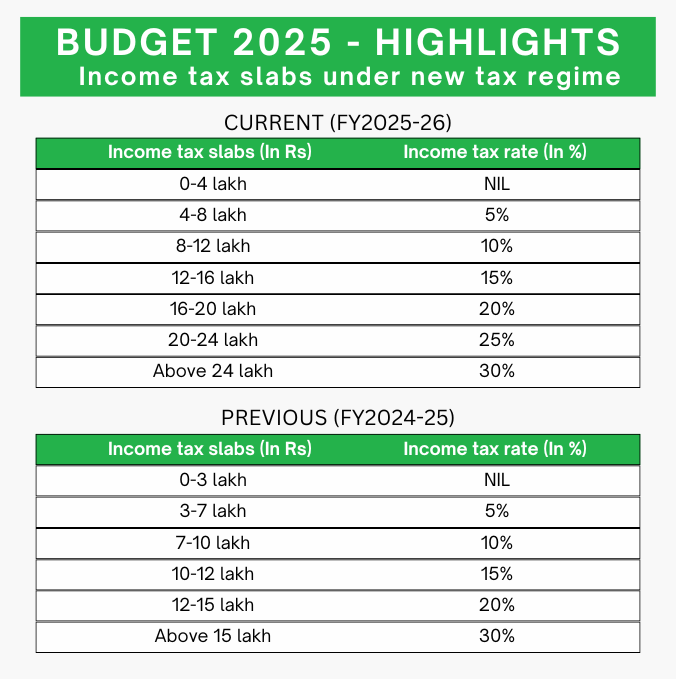
The 2025 Union Budget has introduced significant changes to India’s tax system, impacting both personal finance and broader economic growth. The increase in the tax-free income limit to Rs 12 lakh under the new regime—effectively Rs 12.75 lakh for salaried individuals—marks one of the biggest tax cuts in recent years. While this move increases disposable income, it also raises concerns about its long-term effects on savings and investments.

Key Highlights of Union Budget 2025

The Union Budget 2025 focuses on tax simplification, economic growth, and fiscal consolidation. Key highlights include:

  • Tax Reforms: The new tax regime offers 100% tax relief for incomes up to ₹12 lakh and additional savings at higher income levels.
  • Fiscal Deficit Target: Reduced to 4.4% of GDP in FY26, ensuring fiscal prudence.
  • Capital Expenditure: Growth has moderated to 10% YoY, prioritizing infrastructure projects.
  • Industry Boost: IFSC (GIFT City) tax incentives, MSME classification changes, and ease of doing business reforms.
  • Indirect Tax Reforms: Custom duty reductions on lithium-ion batteries, semiconductors, and life-saving drugs.
  • Investment Reforms: Central KYC registry revamp to simplify investor onboarding.

These reforms collectively aim to increase disposable income, drive consumption, and stimulate sectoral growth while maintaining fiscal discipline.

Impact of Union Budget 2025 on Tax-Saving Investments

Union Budget 2025 aims to simplify the tax structure and increase disposable income, providing a much-needed relief for many. However, the lock-in periods associated with traditional tax-saving instruments like EPF, PPF, NPS, and ELSS have historically acted as a built-in mechanism for financial discipline, helping investors learn about market fluctuations, volatility, risk, and long-term returns. For instance, someone investing in ELSS must stay invested for at least three years, fostering an understanding of market cycles and wealth-building strategies. While the immediate benefits of increased disposable income are clear, without these tax incentives, there is a risk that investors might focus more on short-term spending rather than structured financial planning.

Fiscal Discipline and Deficit Targets

A key focus of Budget 2025 is maintaining fiscal discipline while ensuring sustainable economic growth:

  • Fiscal Deficit Target: Reduced to 4.4% of GDP in FY26 from 4.8% in FY25 (Revised Estimates).
  • Capital Expenditure Growth: Slowed to 10% YoY, indicating a cautious approach to infrastructure spending.
  • Reduction in Subsidies: Down to 1.1% of GDP in FY26 from 1.2% in FY25.
  • Personal Income Tax Revenue Growth: Projected at 14.4%, outpacing overall gross tax revenue growth of 10.8%.

Major Tax Reforms and Reliefs in Union Budget 2025

The budget introduces bold tax reforms aimed at increasing disposable income and simplifying tax compliance:

Union Budget 2025 tax slab

New Income Tax Slabs:

  • No tax payable on income up to ₹12 lakh (₹12.75 lakh for salaried individuals with the standard deduction).
  • Tax savings at different income levels:
    • ₹12 lakh income: ₹80,000 saved (100% relief).
    • ₹18 lakh income: ₹70,000 saved (30% relief).
    • ₹25 lakh income: ₹1,10,000 saved (25% relief).

TDS/TCS Rationalization:

  • Rent exemption threshold: TDS now applies on rent above ₹6 lakh per year (earlier ₹2.4 lakh).
  • Senior Citizen Interest Income Exemption: Increased to ₹1 lakh (from ₹50,000).
  • Liberalized Remittance Scheme (LRS): TCS threshold raised from ₹7 lakh to ₹10 lakh.

Impact on Tax-Saving Investments

While the budget simplifies taxation and increases disposable income, it reduces incentives for traditional tax-saving investments such as EPF, PPF, NPS, and ELSS. These instruments have historically encouraged disciplined saving and long-term wealth creation. The removal of tax incentives could lead to:

  • A shift in investor behavior towards short-term consumption rather than structured financial planning.
  • A decline in long-term savings, which may impact retirement preparedness and wealth accumulation.
  • Reduced participation in equity-linked tax-saving schemes like ELSS, affecting market liquidity and investment growth.

Central KYC Registry: Making Investments Easier

A key highlight of Union Budget 2025 is the revamp of the Central KYC Registry, set to launch in 2025. Currently, investors must complete multiple KYC processes across financial institutions, leading to inefficiencies and delays. A unified KYC system will streamline onboarding, reducing paperwork and enhancing financial inclusion. This initiative is expected to drive greater participation in financial markets, potentially counterbalancing the decline in tax-linked savings.

Economic Growth and Industry Focus

The budget outlines initiatives to boost economic growth across key sectors:

  • Economic Growth and Industry Focus: Enhanced tax incentives for IFSC companies to attract foreign investments and expand global financial services, strengthening India’s position as a financial hub.

  • MSME Support: Increased investment and turnover limits for MSME classification, along with easier credit access and government-backed financial support to boost growth and employment.

  • India Post Expansion: Transforming India Post to provide banking, insurance, and digital financial services, enhancing financial inclusion in rural areas.

  • Jan Vishwas Bill 2.0: Decriminalizing over 100 legal provisions to reduce regulatory burdens, encouraging entrepreneurship, and fostering a pro-business environment.

Indirect Tax Proposals

The budget also introduces key changes in indirect taxation to support industry growth:

  • Custom Duty Cuts:
    • Exemptions on raw materials, chemicals, lithium-ion batteries, and semiconductors.
    • Lower tariffs for motorcycles (previously 50%/25%/15%, now reduced to 40%/20%/10%).
  • Healthcare Support:
    • 36 new life-saving drugs (for cancer, rare diseases) added to the duty-free list.

Sectoral Implications in Union Budget 2025

Adapting Investment Strategies for Union Budget 2025

While the budget offers greater disposable income, investors must plan for long-term financial stability. Countries with strong savings cultures use mechanisms like auto-enrollment in retirement plans, employer-matching contributions, and government-backed savings programs. India should explore similar policies to maintain disciplined investing habits. Investors should also consider diversifying into equity mutual funds and ETFs to maximize returns in the absence of traditional tax-saving incentives.

Conclusion

Union Budget 2025 presents a mix of opportunities and challenges. While tax reforms provide relief and increase disposable income, they also reduce incentives for long-term savings. A balanced approach—spending wisely while maintaining disciplined investments—will be key to long-term financial success.

Note: Mutual fund investments are subject to market risks. Read all scheme-related documents carefully before investing. The past performance of the schemes is neither an indicator nor a guarantee of future performance.

Budget 2025 presents both challenges and opportunities. While tax relief gives people more financial freedom, it also reduces the incentives for long-term savings. Having more disposable income is great, but investors must think ahead to ensure financial stability.

Table of Contents

Ready to make your first investment? Get in touch.